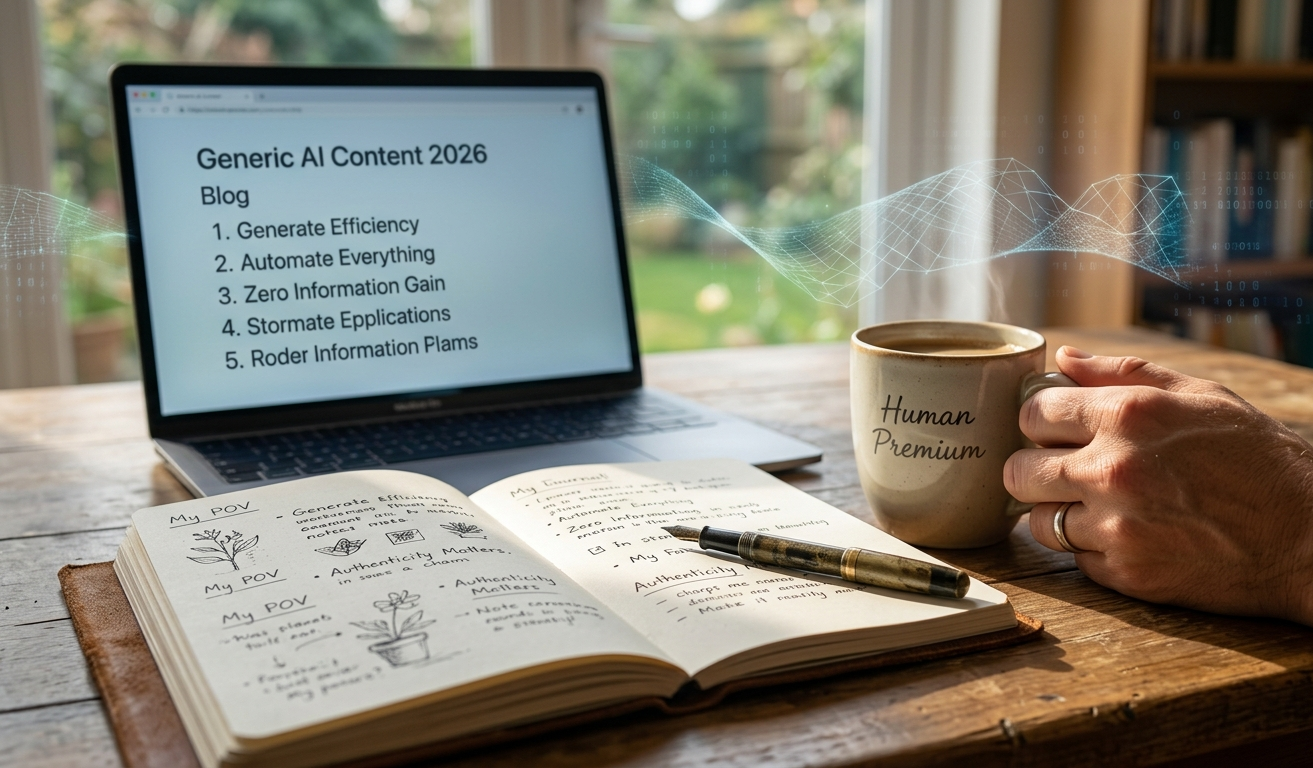
1. Introduction: Drowning in a Sea of “Grey Content”
As we cross the threshold of 2026, the internet has reached a tipping point that few predicted during the AI boom of 2023. We are no longer suffering from a lack of information; we are drowning in it. Every minute, millions of blog posts, LinkedIn updates, and newsletters are blasted into the digital void. However, if you look closely, 90% of them share a haunting similarity. They are grammatically perfect, logically structured, and completely devoid of “soul.”
This is what I call “Grey Content.” It is the byproduct of an over-reliance on Large Language Models (LLMs). While these tools are magnificent at processing data, they lack the one thing that makes a reader stay: The Human Spark. In 2026, the average reader has developed a “sixth sense” for AI. They can smell a machine-generated sentence from a mile away. The result? A massive “Digital Burnout” where audiences are unfollowing generic brands and flocking toward creators who aren’t afraid to be messy, opinionated, and—above all—human.

2. Efficiency vs. Authenticity: The Great Value Shift
For the last three years, the business world was obsessed with Efficiency. “How can we produce 100 blog posts a day?” was the question every CEO asked. We optimized for volume, and for a while, it worked. But in 2026, the market has corrected itself.
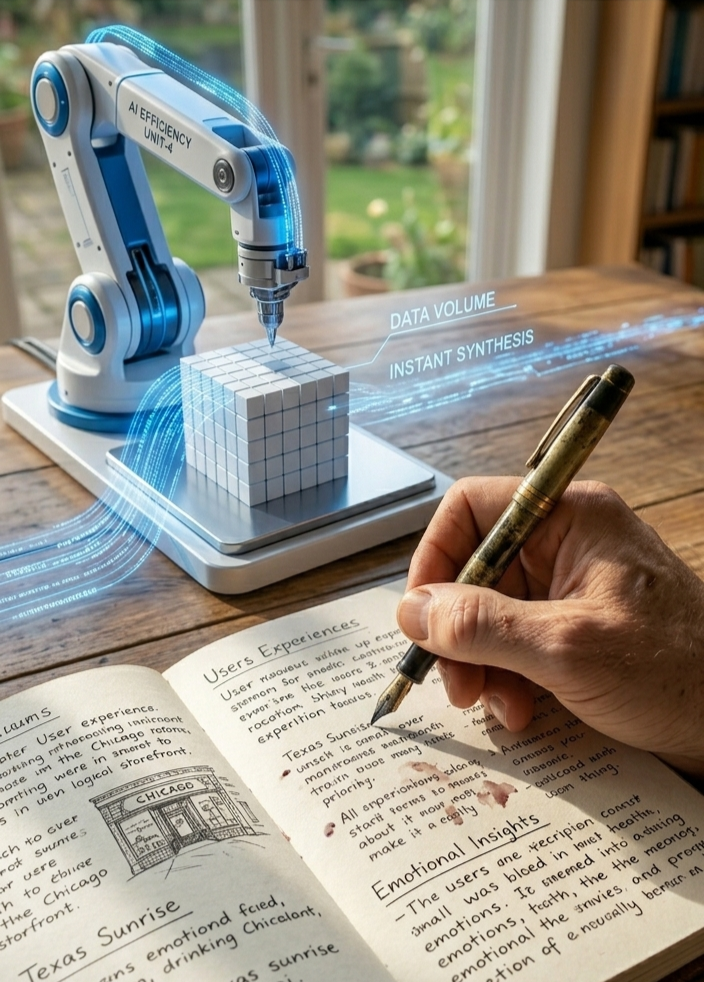
The value has shifted from Efficiency to Authenticity. Think about it this way: AI is a phenomenal calculator, but it isn’t a mathematician. It can tell you that “Studies show remote work increases productivity by 22%,” but it cannot tell you how it felt to sit in a quiet apartment in Seattle, feeling the crushing weight of isolation while your productivity soared.
Readers in 2026 aren’t looking for a Wikipedia summary. They are looking for a Perspective. They want to know: How does this information affect my specific life? AI provides the “What,” but only a human can provide the “So What?”
3. The Search Engine Evolution: Decoding Information Gain
If you want to understand why your traffic is dropping, you need to look at how Google and other search engines have evolved. The old SEO playbooks (Keyword density, backlink spamming) are dead. In their place stands a new king: Information Gain.
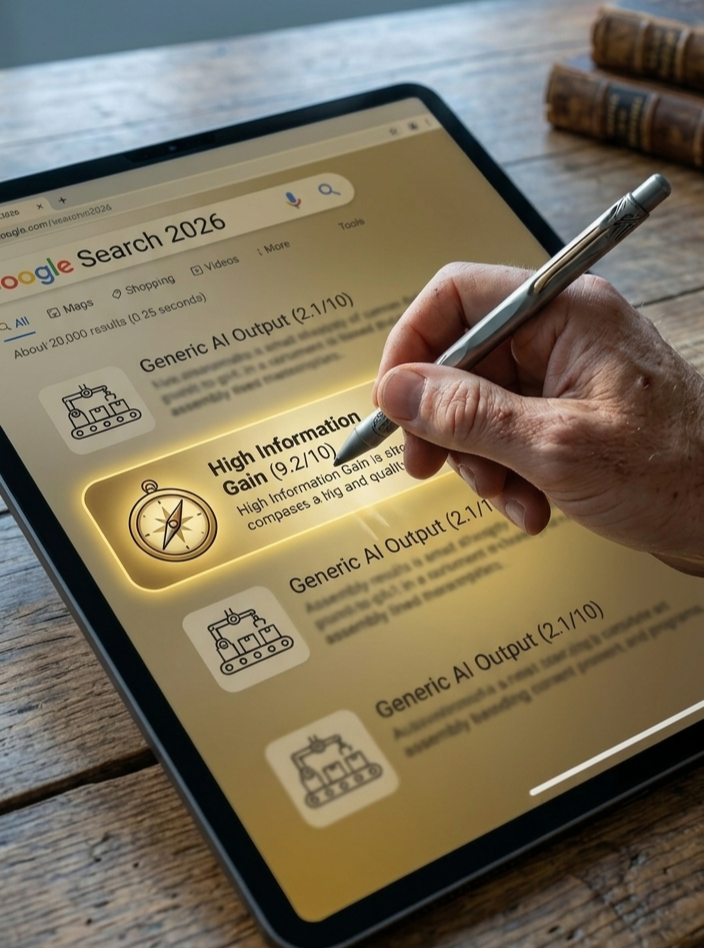
Search engines in 2026 use advanced “Human-Logic” filters. When a crawler visits your site, it asks: Does this article offer a unique insight that isn’t already present in the top 10 results? If you use AI to summarize the top 5 articles on Google, your “Information Gain Score” is zero. Why would a search engine show your page if it’s just a mirror of what’s already there? To rank today, you must include:
- First-Hand Experiments: “I tried this for 30 days…”
- Contradictory Opinions: “Everyone says X, but in my experience, Y is true.”
- Localized Nuance: How a global trend affects a specific community or industry.
This is the “Human Premium.” It is the data that doesn’t exist in a training set.
4. Why “Human-Only” is the New “Organic”

In the early 2000s, the food industry saw a massive shift toward “Organic” labeling. People were tired of processed chemicals and wanted something grown in soil. We are seeing the exact same phenomenon in the content industry.
Global brands are now explicitly advertising “Human-Only Content.” Agencies are charging a 50% to 100% premium for articles written without the help of a generative AI draft.
Why is this happening?
- Legal Safety: Companies are terrified of AI hallucinations and copyright infringements.
- Brand Loyalty: You cannot fall in love with a bot. Brands realize that to build a “tribe,” they need a human face and a human voice.
- The Nuance Factor: AI is bad at sarcasm, bad at cultural references, and terrible at understanding the “vibe” of a specific moment.
5. The Psychology of Connection: Why We Crave Imperfection
There is a psychological concept known as the “Pratfall Effect.” It suggests that people who make mistakes are perceived as more likable than those who are perfect. AI is designed to be perfect. It never stutters, it never uses “slang” incorrectly, and it never gets angry.
But humans do all of those things.
In 2026, the “Human-Only Premium” is built on imperfection. It’s the writer who admits they don’t have all the answers. It’s the blogger who shares a failed business story. This vulnerability creates a bridge of trust that no algorithm can cross. When you share a struggle, the reader thinks, “Me too.” That moment of connection is where the sale happens.
6. Strategy: How to Build Your “Human Advantage”
If you are a content creator or a business owner, how do you capitalize on this 2026 trend? You need a Human-First Framework.
Step 1: The Anecdote Entry: Never start a blog post with a definition. Start with a story. If you’re writing about financial planning, start with the time you lost $500 on a bad investment.
Step 2: The Radical Opinion: AI is programmed to be “safe” and “neutral.” To be a premium human creator, you must be bold. Take a stand. If you think a popular industry tool is overrated, say so—and explain why.
Step 3: The “I” Statement: Count how many times you use the word “I” or “We” in your writing. If it’s zero, your content is likely too academic. Personalize your insights.
Step 4: Interview Real People: AI cannot pick up the phone and call an expert. You can. Including a 2-minute quote from a real person in your industry adds a layer of authority that a bot cannot replicate.
7. The Future of the “Content Economy”
As we look toward 2027 and beyond, the content economy will likely split into two tiers:
1. Tier 2 (Commodity Content): Low-cost, AI-generated news updates, weather reports, and basic tutorials. This will be free and everywhere.
2. Tier 1 (Premium Content): High-cost, human-led analysis, thought leadership, and storytelling. This will sit behind paywalls and drive the most loyal customers.
The question you have to ask yourself is: Which tier do I want my brand to live in?
8. Conclusion: Don’t Be a Machine
The greatest irony of 2026 is that to succeed in a world of high-tech AI, you must become “lower-tech.” You must return to the basics of human communication: storytelling, empathy, and honesty.
The AI Gold Rush isn’t about who can use the tools the fastest; it’s about who can use the tools to handle the “boring” stuff so they have more time to be unapologetically human. Stop trying to sound professional. Start trying to sound like you. Because in a world of infinite bots, your voice is the only thing that cannot be duplicated.